
Quantum noise reduction by frequency dependent squeezing
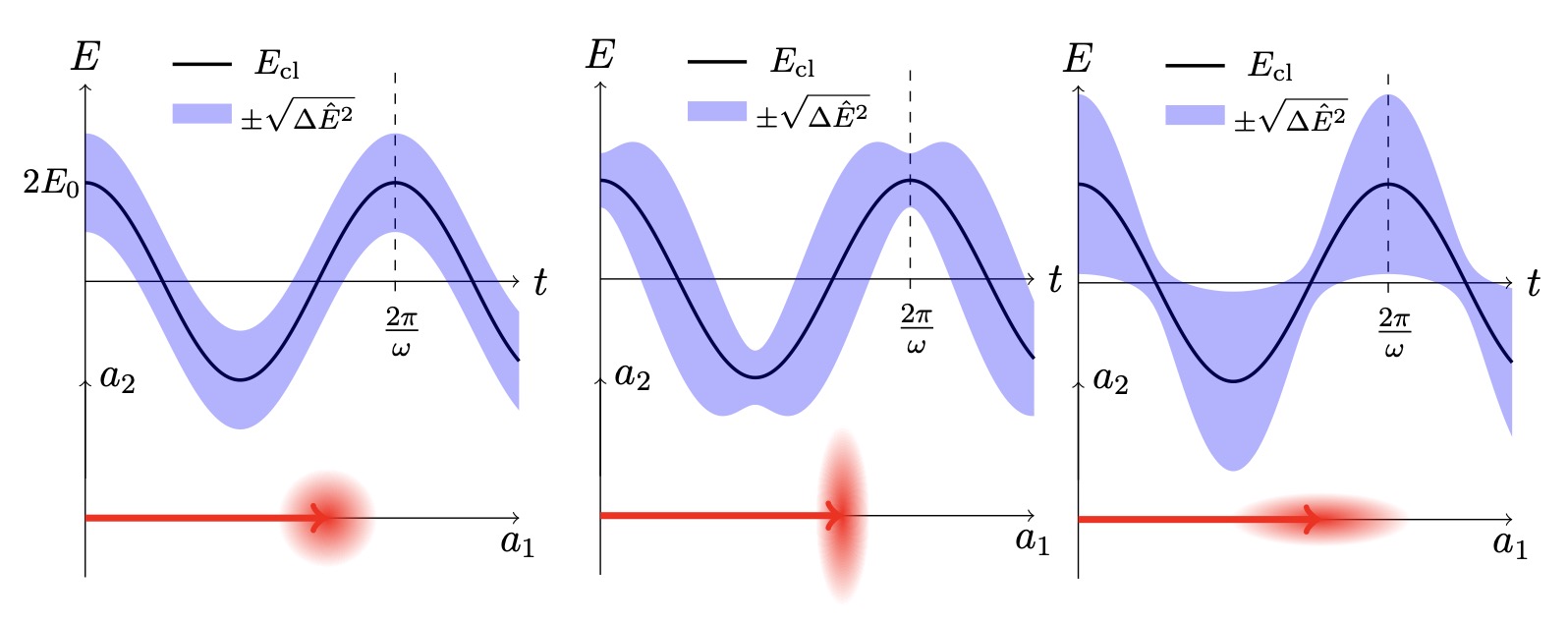
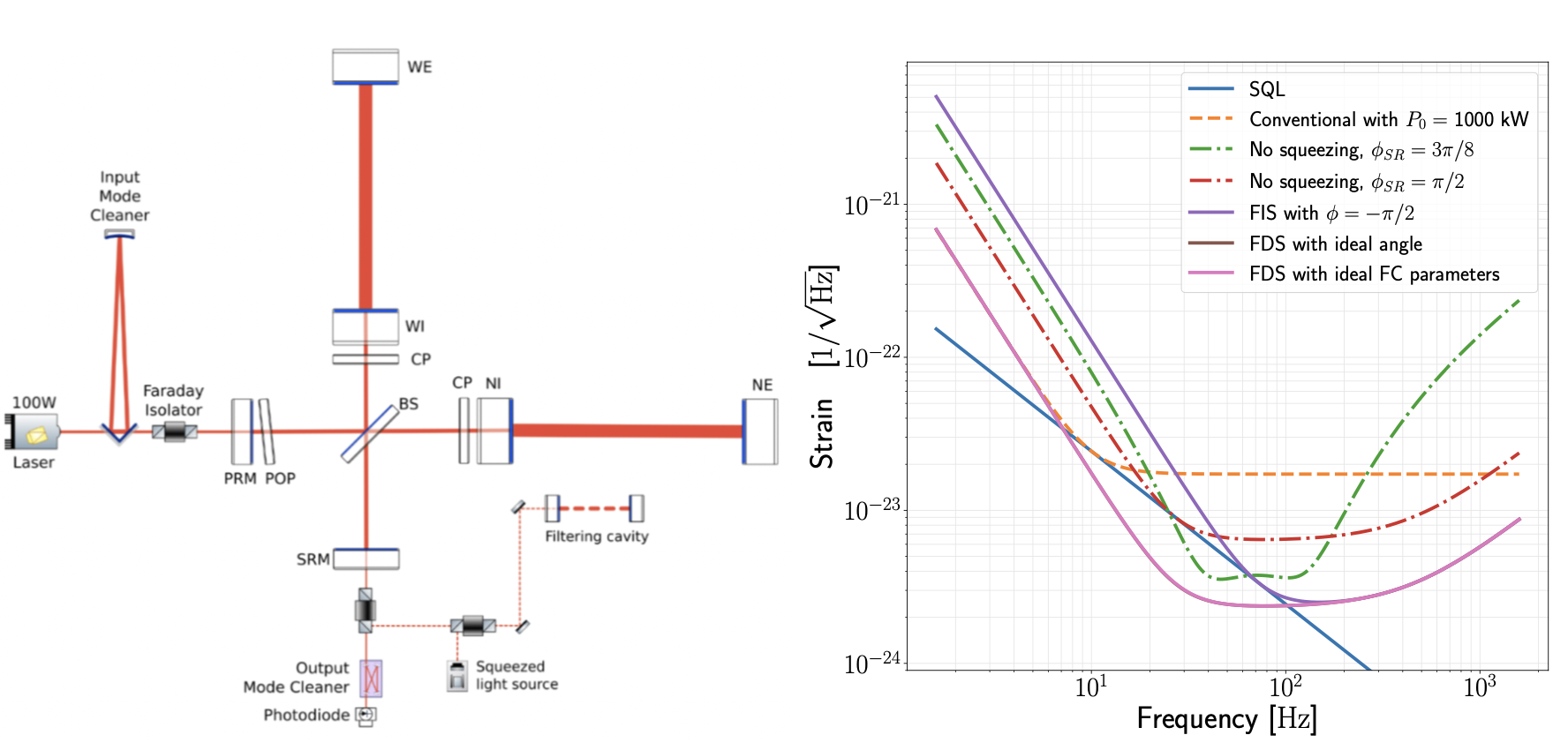
The credit of the left figure is due to Raffaele Flaminio (2020) .
Description
The work presented here is done during April to June in 2023, in the research internship as academic requirement towards finishing the master program M2 ICFP (mentioned in the homepage). The internship work is defended on July 2nd, 2023 at École Normale Supérieure in Paris.
The internship work can be divided into two parts. The first consists of theoretical investigation of the quantum noise and frequency dependent squeezing technique in interferometric gravitational wave (GW) detectors. The starting point is canonical quantization of a monochromatic light field. The notion of coherent and squeezed state is demonstrated for the monochromatic field. Generalizing to continuous frequency in the context of GW detection, with the so-called sideband expansion and two-photon formalism, the quantitative description of quantum noice for Michelson-Morley interferometer in terms of spectral density, is derived from first principle. Similar results for more modern detectors, with power and signal recycling cavities, can be derived analogously. The first part concludes with re-plotting certain sensitivity curves through coding in Python. The second part of the work is more practical. Numerical simulation is implemented to explore the parameter space of the concurrent Virgo cavity configuration (in the so-called detuned resonant sideband extraction state), in order to look for the optimal configuration and examine the quantitative increase of sensitivity compared to those of previous Observational runs.
The theoretical aspect of the quantum noise is what drove me to explore such a project. This is another place where quantum phenomena meet gravity, apart from considering quantum fields in curved spacetime or even a full quantum gravity theory. Interesting physics ofen occurs at extreme conditions. The fact that the precision requirement is so high that Heisenberg’s uncertainty principle comes into play, reflects one example of such extreme conditions. Moreover, the theories can actually be tested at, say, the LIGO site. Cutting-edge quantum physics and technology are being actively developped in the GW detection community, such as the entanglement of macroscopic quantum systems. I believe there are still many interesting questions to explore in this field, which is always intriguing to be aware of.
More details can be found in the internship report (2023).
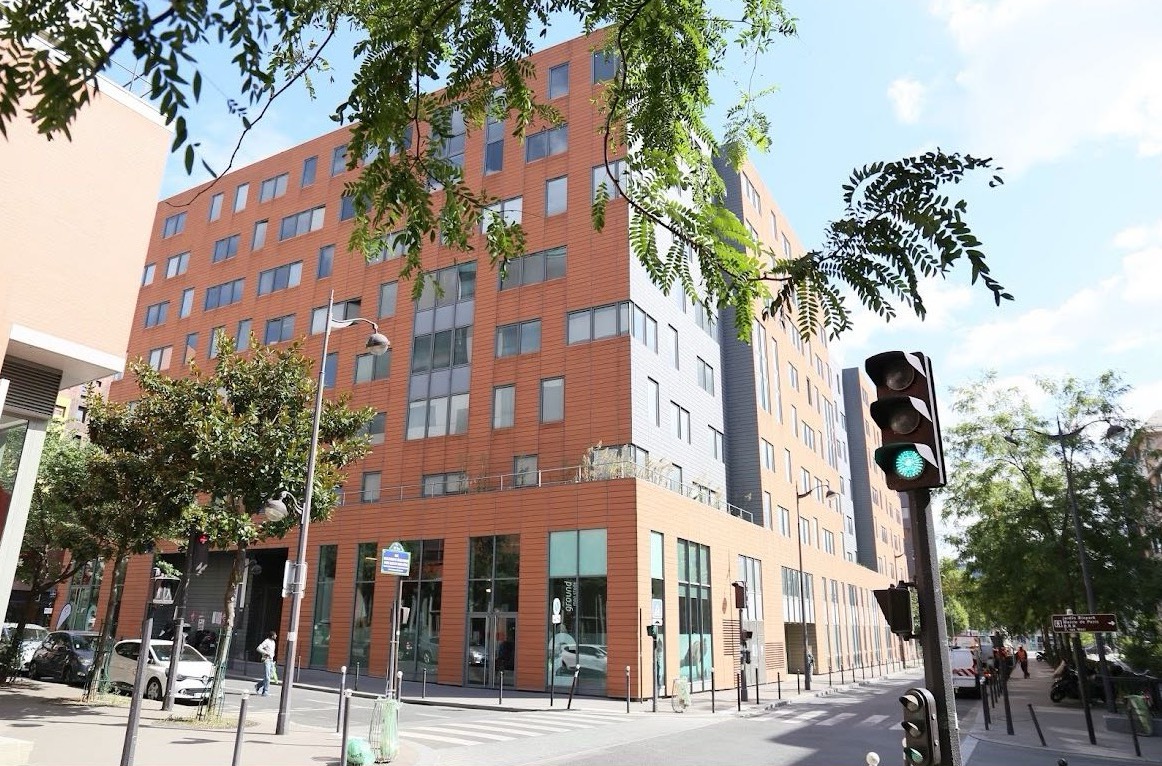
Bâtiment Condorcet of Université Paris-Cité, 4th floor AstroParticule et Cosmologie