
The first law of point particle binary system
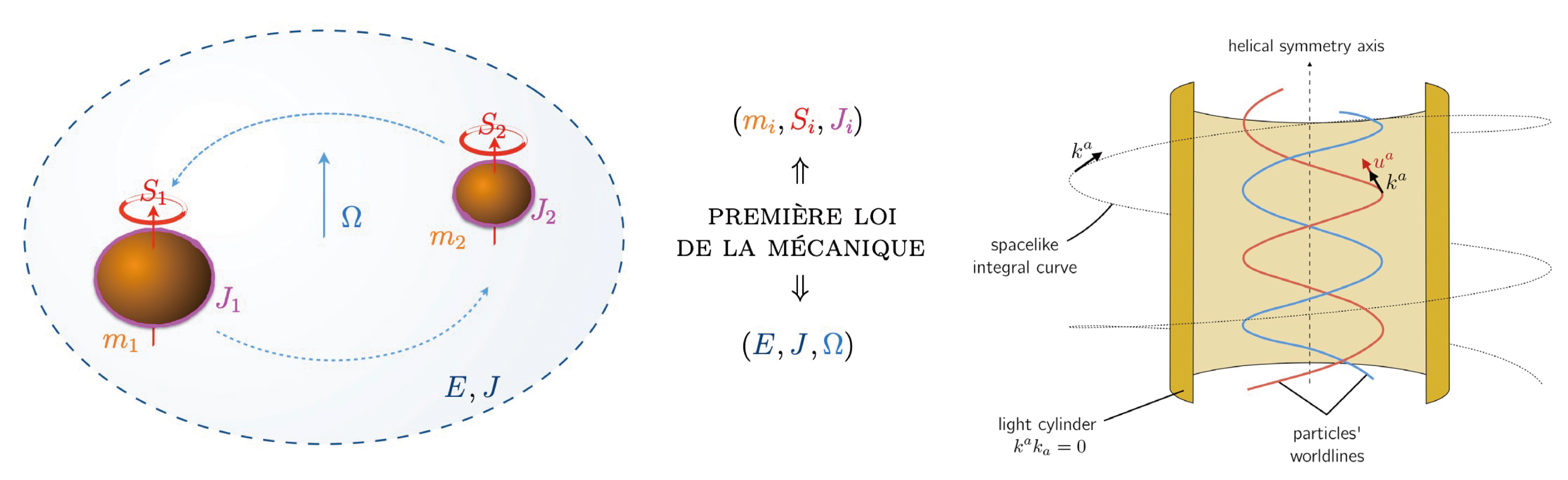
Figure on the left is taken from the cover of internship report of Paul Ramond (2018). The right figure is taken from Ref. [6].
Description
The project started when I began my internship at l’Observatoire de Paris, Laboratoire Univers et Théories (LUTH), during March to July in 2024. The internship, worth 30 ECTS among the 60 for the whole academic year, is a requirement to complete the second year of master High Energy Physics at École Polytechnique. The master thesis is defended on July 19th, 2024 in the conference room of Laboratoire Leprince-Ringuet at École Polytechnique.
The project focuses on the first law of mechanics for multipolar particle binary systems, which is a variational formula relating global quantities of the system, such as the ADM energy and angular momentum, to the local quantities, i.e., the individual multipole moments of the constituents. The first law finds its applications in various techniques in waveform modelling, and can also serve as a bridge connecting these techniques, informing the calculation of one through the results of the other. It has already been implemented to calculating higher order post-Newtonian coefficients[1], relating the binding energy of the binary to the redshift observable which is crucial for inferring the waveform phase[2], extracting the redshift observable in numerical relativity simulation[3], and compare the result of binding energy from the first law with that calculated by gravitational self-force[4].
What is done in this piece of work includes collecting all the prerequisites for deriving the first law at dipolar order in the multipole expansion [5,6], as well as some preliminary calculations to extend the formula to quadrupole order. An investigation of extended body in General Relativity (GR) is first carried out, followed by a description of the differential geometry method developed by Iyer and Wald to derive a general variational formula. The latter is further exploited in the specific scenario of the multipolar particle binary system. The first law to dipolar order is finally derived by evaluating the integrals and using techniques from the 3+1 formalism in GR. Strategies for extension to quadrupolar order are stated and the work is currently underway, even though the internship itself is finished.
More details can be found in Master Thesis (2024).
References
[1] Alexandre Le Tiec, Luc Blanchet, and Bernard F. Whiting. First law of binary black hole mechanics in general relativity and post-newtonian theory. Phys. Rev. D, 85:064039, Mar 2012.
[2] Alexandre Le Tiec, Enrico Barausse, and Alessandra Buonanno. Gravitational self-force correction to the binding energy of compact binary systems. Phys. Rev. Lett., 108:131103, Mar 2012.
[3] Aaron Zimmerman, Adam G. M. Lewis, and Harald P. Pfeiffer. Redshift factor and the first law of binary black hole mechanics in numerical simulations. Phys. Rev. Lett., 117:191101, Nov 2016.
[4] Adam Pound, Barry Wardell, Niels Warburton, and Jeremy Miller. Second-order self-force calculation of gravitational binding energy in compact binaries. Physical Review Letters, 124(2), January 2020.
[5] Paul Ramond and Alexandre Le Tiec. Multipolar particles in helically symmetric spacetimes. Classical and Quantum Gravity, 38(13):135022, June 2021.
[6] Paul Ramond and Alexandre Le Tiec. First law of mechanics for spinning compact binaries: Dipolar order. Phys. Rev. D, 106:044057, Aug 2022.




Paris Observatory, Meudon site